

Obstetrics
Your pregnancy, through to birth
Comprehensive pregnancy care at the practice, ultrasound scans on site, and delivery at the Clinique de la Muette (Paris 16th), a five-minute walk away.
Updated on 20 November 2026
The pathway
From registration to birth
- Pregnancy registration — first consultation, dating scan and setting up your care.
- Monthly follow-up at the practice — consultations, scans across the three trimesters, screening and prescriptions.
- Preparing for delivery — anesthesia (anaesthesia) consultation at the clinic, decisions regarding the epidural, information on the course of labor (labour). During labor, do not eat: a cesarean (caesarean) section may become necessary and anesthesia is safer when you are fasting (8 hours).
- Documents and quotation — for delivery and cesarean section, you receive by e-mail an information sheet, an informed-consent form and a detailed quotation, to be accepted by electronic signature.
- Delivery and aftercare — at the Clinique de la Muette, followed by a postnatal consultation and pelvic floor assessment at the practice.
- Uterus
- Embryo
- Bladder
- Pubic symphysis
- Developing placenta
Your care
Obstetric consultations and procedures
General information. After your consultation, you receive by e-mail detailed information tailored to your situation, to be accepted by electronic signature when a procedure is scheduled.
Pregnancy care
See the diagram
- Belly button
- Uterus
- Fundal height: from the pubic bone to the top of the uterus
- Pubic bone
- Top of the uterus (fundus)
- Placenta
- Fetus
- Amniotic fluid
Ultrasound scans across the three trimesters
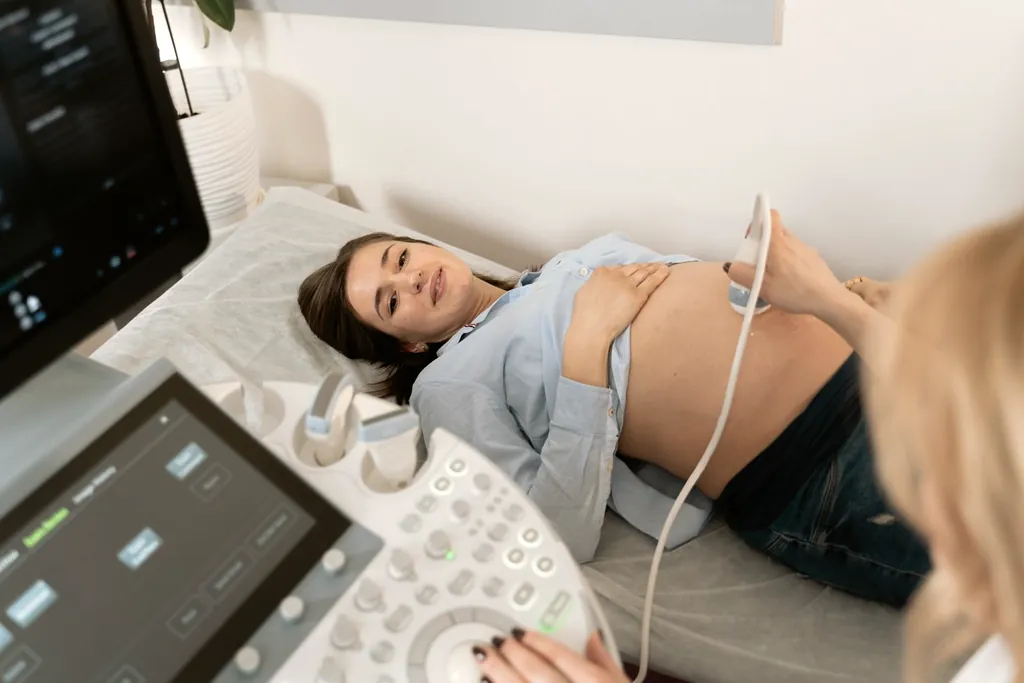
Obstetric scans performed at the practice on the GE Voluson™ Expert 22 (2D, 3D, 4D and HDlive), including twin pregnancies, by Dr Mahdhi-Basli, who specializes in fetal medicine. Images are displayed on a large screen throughout the examination. These scans have their own page: Pregnancy ultrasound.
Information sheet · Ultrasound scans during pregnancy PDFSee the diagram
- Gel
- Abdominal wall
- Placenta
- Fetus
- Amniotic fluid
- Ultrasound waves
Delivery

Dr Gatri delivers at the Clinique de la Muette (Paris 16th), a five-minute walk from the practice. Vaginal birth. An epidural or spinal anesthesia is offered to all women who wish to have one; you can also give birth without regional analgesia, and this choice can be reconsidered during labor. You stay at the maternity unit for 3 days after the birth. Presentation, the course of labor and any procedures (instrumental delivery, episiotomy) are explained during third-trimester consultations.
See the diagram
- Placenta
- Uterus
- The baby
- Bladder
- Cervix
- Rectum
- Umbilical cord
Induction of labor
See the diagram
- Uterus: induction brings on its contractions
- The baby
- Favorable cervix: softened and already slightly open
- Vagina: where the prostaglandin gel is placed
- Membranes: they may be ruptured (with an oxytocin drip) or swept by a finger passed inside the cervix
Artificial induction of labor where medically indicated, or planned delivery after information and agreement. The conditions (term, cervical status) and the process are detailed beforehand. For a planned birth without a medical indication, it may happen that the team cannot carry out the induction because not all the organizational (organisational) and safety conditions are met. If it was suggested to you for reasons of the maternity unit's organization (organisation), you are free to refuse it, without this changing the quality of the care you will receive.
Information sheet · Induction of labour without medical indication PDFCesarean section
Cesarean section planned for medical reasons, or decided during labor: labor stops progressing, the baby does not tolerate the contractions well, the baby's position prevents a vaginal birth, or an event makes it necessary to act quickly. The procedure, the days that follow and recovery are explained during your consultation.
Information sheet · Planned caesarean section PDF Information sheet · Caesarean section during labour PDFSee the diagram
- Opening the uterus allows the baby to be born
- Wall of the uterus
- Bladder
- Closed with stitches
- Bladder
Postnatal consultations
See the diagram
- Uterus: it gradually returns to its size before pregnancy
- Bladder
- Vagina
- Rectum
- Pelvic floor muscles (perineum)
Follow-up consultation after delivery: healing, contraception, return to activity and pelvic floor assessment. After a vaginal birth, the follow-up consultation takes place 2 to 3 weeks after the birth. If urinary incontinence persists at three months, pelvic floor rehabilitation may be offered at the practice (contact-free StarFormer® chair).
Information
Risks and complications: what to know before deciding
Every operation carries risks; Dr Gatri goes through them with you at the consultation and gives you the practice's information sheets.
- For a vaginal birth — the practice's information sheet states that an episiotomy (incision of the perineum) may be decided during the birth; it is not done routinely. An instrumental delivery (vacuum cup, forceps, spatulas) may be needed to help the birth. More rarely, labor may have to end with a cesarean section decided during labor. During the birth, the perineum may tear. A simple tear is common and is repaired with dissolvable stitches. A deeper tear may reach the anal sphincter: this is a third- or fourth-degree tear. After the birth, heavy bleeding may occur: this is postpartum hemorrhage (haemorrhage), which is rare. To prevent it, you will be offered an injection of oxytocin. Pain in the perineum and afterpains follow the birth. Afterwards, the perineal scar may come apart or become infected. The risk of phlebitis or pulmonary embolism is increased after the birth; these complications remain rare.
- Common and not serious — a cesarean is a common procedure that is straightforward in most cases. Afterwards, the practice's information sheet states that the first 24 hours are often painful and require painkillers. A hematoma (haematoma) or infection (abscess) of the scar may occur, usually needing only simple local care. A usually mild urinary infection is not uncommon after a cesarean. Unless otherwise indicated, an anticoagulant is prescribed during the hospital stay to reduce the risk of phlebitis — a clot in a leg vein — or pulmonary embolism. Moderate vaginal bleeding is normal and may last up to three weeks.
- Rare — during the operation, injury to organs near the uterus may occur exceptionally: the bladder, the urinary tract, the bowel or blood vessels, requiring specific surgical management. In the exceptional case of life-threatening bleeding from the uterus, a transfusion of blood or blood products may be needed; if the specific medical and surgical treatments are ineffective, it may very exceptionally be necessary to perform a hysterectomy to stop the bleeding. Exceptionally, severe bleeding or infection may occur in the following days and require specific treatment or a further procedure. As with any surgery, a cesarean may very exceptionally involve a life-threatening risk or serious after-effects.
- What increases them — certain risks may be increased by your condition, your history or by treatment taken before the operation: it is essential to inform the doctor of your personal and family history, of all the treatments and medicines you take, and of any allergies. The sheet adds that smoking increases the risk of surgical complications of any operation, and states that stopping smoking six to eight weeks before the procedure removes this additional risk.
- Warning signs — when to call — once home, the practice's information sheets state: after a vaginal birth, if heavy bleeding, fever, pain or redness in a breast, pain in a calf, breathlessness, severe headaches, problems with your vision, difficulty passing urine, pain that does not ease, sadness or anxiety that does not go away, or any other abnormality appears, it is essential to inform your doctor without delay; after a planned cesarean section, if pain, bleeding, vomiting, fever, pain in the calves or any other abnormality appears, it is essential to inform your doctor.
- The sheets you are given: Information sheet · Vaginal birth PDF Information sheet · Caesarean section during labour PDF Information sheet · Planned caesarean section PDF Induction of labor and pregnancy ultrasound each have their own sheet, handed to you at the consultation: Information sheet · Induction of labour without medical indication PDF Information sheet · Ultrasound scans during pregnancy PDF The induction sheet sets out the conditions required — a uterus with no scar, a due date known precisely, a pregnancy of at least 39 weeks of amenorrhea (amenorrhoea), a favorable cervix, soft and already slightly open, and your request or your agreement — and states that, when the necessary conditions are met, the length of labor, the possibility of a cesarean section and the condition of the baby at birth are no different from what they are in a birth that starts spontaneously. As in a spontaneous birth, contractions of the uterus that are too strong, or a halt in the opening of the cervix that requires a cesarean section, may occur.
Frequently asked questions
Your questions, our answers
When should I book my first pregnancy appointment?
As soon as the test is positive. The first consultation dates the pregnancy by ultrasound, opens your care and allows the pregnancy to be registered. The first-trimester scan falls within a narrow window: the practice's information sheet states that the measurement of the nuchal translucency, done if you wish, contributes to screening for trisomy 21 and can only be interpreted between 11 and 13 weeks of amenorrhea (amenorrhoea). Appointments are booked on Doctolib with Dr Gatri (reason “Première consultation de grossesse” — first pregnancy consultation), or by telephone through the secretariat.
Who looks after my pregnancy at the practice?
Dr Chaima Gatri, a gynecologist (gynaecologist) and obstetrician, holds the monthly consultations from registration through to delivery, and she is the doctor who delivers your baby at the Clinique de la Muette. Dr Amel Mahdhi-Basli, who specializes in fetal (foetal) medicine, performs the three trimester scans at the practice, twin pregnancies included. Both doctors consult in French and in English, at 42 avenue Mozart.
The three trimester scans: where and when?
At the practice, on the GE Voluson Expert 22, by Dr Mahdhi-Basli: the images are shown on a large screen throughout the examination and the report is handed to you in print. The practice's information sheet places the three screening scans, one per trimester, preferably at around 12–13, 22–24 and 32–34 weeks of amenorrhea. You may eat before coming. These scans have their own page: Pregnancy ultrasound.
Where will I give birth, and how do I register with the maternity unit?
Dr Gatri delivers at the Clinique de la Muette, 46-48 rue Nicolo, Paris 16th, a five-minute walk from the practice. The anesthesia (anaesthesia) consultation takes place there ahead of the birth, and your choices regarding the epidural are prepared there. The practice's quotation file, signed electronically, is required before any booking of the operating or delivery room at the clinic. Pre-admission to the clinic is then a mandatory step: it is done online, on the clinic's patient portal (ramsayservices.fr — the file given by the practice carries the QR code), or in person at the pre-admission desk during the anesthesia consultation; you present your identity document, your carte Vitale, your complementary insurance card and the practice's signed quotation. The clinic does not offer direct billing (tiers payant) for complementary insurance: on discharge it gives you the receipted invoices for your insurer. The practice's quotation covers Dr Gatri's fees; clinic charges and the fees of the anesthetist (anaesthetist) are arranged directly with the clinic.
When is a cesarean section planned?
When conditions, for you or for your baby, are not favorable for a vaginal birth — that is what the practice's information sheet states. The operation is performed under regional anesthesia (epidural or spinal). It lasts about 45 minutes to 1 hour; the abdomen is opened, usually through a horizontal incision, then the uterus. In most cases, you will be admitted to hospital the day before the cesarean section. You must fast for 8 hours before the operation. Dr Gatri plans discharge 4 days after the cesarean; the sheet states that moderate bleeding may last up to three weeks, and that it is wise to wait a year before starting another pregnancy. Showers are possible a few days after the operation; wait 3 weeks before taking a bath. It is recommended to wait until the bleeding has stopped before resuming sexual intercourse. The follow-up consultation takes place 3 to 4 weeks after the operation. A cesarean section does not prevent you from having other pregnancies. Except in certain cases, a vaginal birth can most often be considered for subsequent pregnancies. The information sheet, the consent form and the quotation reach you before the date.
What is an induction, and when is it possible?
An induction brings on contractions to start labor (labour). For a planned birth without a medical indication, the practice's information sheet sets these conditions: a uterus with no scar; a due date known precisely; a pregnancy of at least 39 weeks of amenorrhea, about eight and a half months; a favorable (favourable) cervix, softened and already slightly open; your request or your agreement, after being informed about how it takes place and its risks. With those conditions met, the sheet states that the length of labor, the possibility of a cesarean section and the condition of the baby at birth are no different from what they are in a birth that starts spontaneously. It also states that induction without a medical reason does not, at present, bring any proven medical benefit, and that, if you asked for the induction, you can change your mind as long as it has not started. You are admitted to the maternity unit, usually on the morning of the induction, and the method chosen is explained beforehand.
Is my pregnancy covered at 100%?
From the first day of the sixth month of pregnancy, the Assurance maladie covers medical costs at 100% of its tariff, excluding excess fees. Before that, the compulsory antenatal examinations are already covered at 100% of its tariff, excluding excess fees; other consultations, scans and tests are partly covered by the Assurance maladie. The practice applies direct billing to the French national health insurance (tiers payant): with an up-to-date carte Vitale, you do not pay that part upfront. What remains payable by you includes the excess fee (dépassement d'honoraires), which may be reimbursed by your complementary insurer (mutuelle), depending on your policy. Fees for delivery and for a cesarean (caesarean) section are set out in a detailed quotation. The full picture is in “Fees and reimbursement”, further down.
What happens after the birth?
You are seen again at the practice for a postnatal consultation: healing, return to activity, contraception and a pelvic floor assessment. Bleeding, called lochia, follows the birth and gradually decreases. If you do not want another pregnancy soon, effective contraception should be started no later than 21 days after the birth; combined estrogen-progestogen (oestrogen-progestogen) contraception must not be used before six weeks. If urinary incontinence persists at three months, pelvic floor rehabilitation can be carried out at the practice on the StarFormer® chair, clothed and without a probe.
Fees
Fees and reimbursement
- First pregnancy consultation: €160.
- Pregnancy follow-up consultation: €120 to €160.
- Pregnancy consultations, obstetric scans and obstetric procedures are partly covered by the Assurance maladie, and at 100% of its tariff, excluding excess fees, for the compulsory antenatal examinations from pregnancy registration and for all medical costs from the first day of the sixth month. The practice applies direct billing to the French national health insurance (tiers payant): with an up-to-date carte Vitale, you do not pay that part upfront. What remains payable by you includes the excess fee (dépassement d'honoraires), which may be reimbursed by your complementary insurer (mutuelle), depending on your policy.
- Delivery — Dr Gatri's fee: €2,200. This fee includes neither the anesthesiologist nor the clinic charges.
- All fees and the framework: Fees.
Appointments
Book an appointment
Appointments can be booked online via Doctolib or by telephone through the secretariat: +33 1 40 72 00 55.
Doctolib — Dr Chaima Gatri