
Care · Gynecological laser
Gynecological laser: dryness, urinary leaks, laxity — Fotona IntimaLaser, in Paris 16th
A laser treatment performed at the practice, during a consultation — no hospital stay — by Dr Chaima Gatri, OB-GYN and gynecological (gynaecological) surgeon, 42 avenue Mozart, Paris 16th. English-speaking practice.
Updated on 19 November 2026
Indications
Who is it for?
Gynecological laser addresses common, often unspoken concerns that weigh on daily and intimate life. Here is what the practice offers it for, on its own or alongside other treatments*; patients followed at the practice most often describe an improvement in their comfort; a result remains specific to each person, and this treatment guarantees no result.
- Vaginal dryness and discomfort at menopause — dryness, burning, pain during intercourse, urinary discomfort: the genitourinary syndrome of menopause; the laser is offered alongside local treatments, or when they do not suit you. Information sheet · Vaginal laser — mild urinary leakage and dryness PDF
- Mild to moderate urinary leaks — when coughing, laughing or exercising; the laser is offered alongside pelvic floor rehabilitation, or when it is not enough.
- Vaginal laxity — particularly after one or more deliveries; offered on its own or with pelvic floor rehabilitation. With the laser, a course of three 30-minute sessions, four weeks apart, at the practice; the number of sessions is reassessed with Dr Gatri as the treatment progresses: see the Vaginal tightening page. If the complaint is gaping or a prolapse, different management is discussed. Surgical tightening (vaginoplasty) is performed at the Clinique de la Muette. Information sheet · Vaginal laser — vaginal laxity PDF
- HPV-related lesions of the cervix — laser vaporization (vaporisation) when the lesion lends itself to it, after colposcopy and biopsy; conization remains the other route. Information sheet · Laser destruction of lesions of the cervix PDF
- Genital warts (condylomas) — laser vaporization. Information sheet · Laser treatment of genital warts PDF
- Mild prolapse — early-stage pelvic organ descent; the laser is offered alongside pelvic floor rehabilitation and a pessary.
- Cesarean (caesarean) section scar — scar treatment at the practice, as a continuation of your obstetric care.
- Laser labiaplasty — reduction of the labia minora at the practice, in a single session of about 45 minutes, under local anesthesia (anaesthesia), with a check-up consultation 15 days later: see the Labiaplasty page.
- Laser clitoral hood reduction (clitoridoplasty) — at the practice, in a single session of about 30 minutes, under local anesthesia, with a check-up consultation 15 days later: see the Intimate surgery page. Information sheet · Clitoral hood reduction by laser — functional indication PDF (reduction clitoroplasty)
The indication is established by Dr Gatri during a prior consultation: she determines whether laser is suited to your situation, and where it fits alongside other treatments.
The technology
How does the laser work?
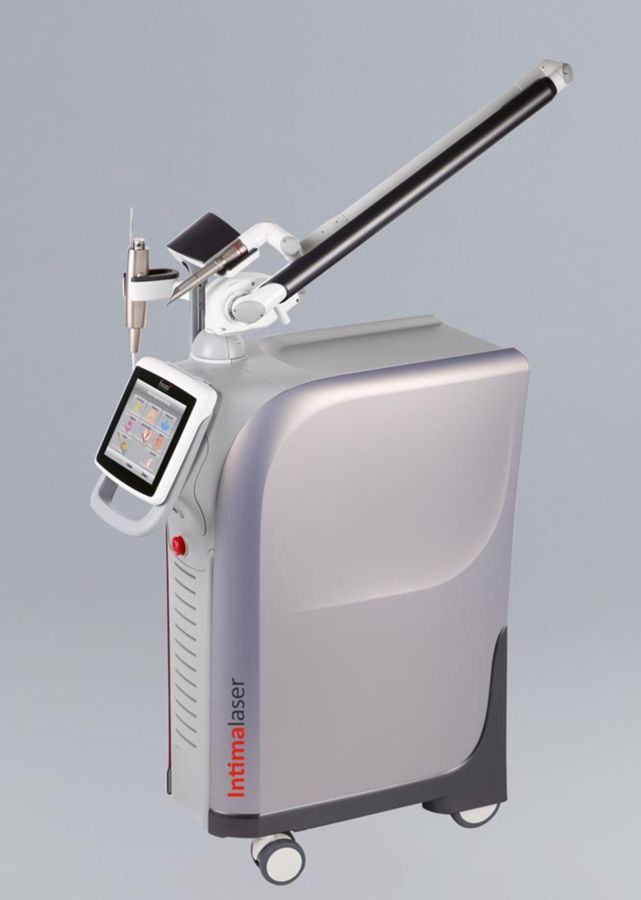
The TimeWalker® IntimaLaser™ PRO is Fotona's laser platform dedicated to gynecology. The beam delivers controlled thermal energy to the mucosa or the skin. For treatments, it acts without any incision: through the natural route for vaginal indications, at the surface for a C-section scar or genital warts. For labiaplasty and clitoral hood reduction, the beam is what removes the excess tissue and seals as it goes: these are surgical procedures. Treatment is performed in the gynecological position, like an examination, with no hospital stay; always under local anesthesia (anaesthesia), for treatments as for procedures.
- The laser, applied inside the vagina
- Controlled thermal energy, delivered to the mucosa
How it works
Your treatment, step by step
- Prior consultation — gynecological examination, confirmation of the indication, information on alternatives, written quotation.
- Treatments: several 30-minute sessions — at the practice, performed by Dr Gatri, under local anesthesia (anaesthesia); most often three sessions, four weeks apart for urinary leaks and for vaginal laxity; for dryness, their spacing is set with her; for the scar, the number and spacing of sessions are set with her according to the indication. HPV lesions and genital warts — for cervical lesions, one session, with a first check-up 3 months later; for genital warts, a number of sessions that Dr Gatri sets out for you, and a check-up 3 months after the session. The two surgical procedures performed with the laser — labiaplasty and clitoral hood reduction — are done at the practice in a single session, under local anesthesia, with the aftercare and the risks of surgery (see the Risks and complications section below): about 45 minutes for labiaplasty, about 30 minutes for clitoral hood reduction. For these two procedures, a few absorbable stitches are sometimes needed.
- Back to your activities — after a treatment, right away; after laser labiaplasty or clitoral hood reduction, ordinary activity from the next day. The instructions are detailed under “Aftercare and precautions”, further down this page.
- Follow-up — a check-up consultation if needed after a treatment; 3 months after the session for cervical lesions and genital warts; 15 days after the session for laser labiaplasty and clitoral hood reduction.
 ▶
Information
Aftercare and precautions
Laser treatment is carried out during a consultation, at the practice, with no hospital stay. Here is how it goes and what to observe afterwards, as Dr Gatri explains it to you at the prior consultation.
- The sessions — for treatments, several 30-minute sessions at the practice (most often three), performed by Dr Gatri, four weeks apart for urinary leaks and for vaginal laxity, spaced as set with her for dryness, and according to the indication for the scar; for cervical lesions, one session, with a first check-up 3 months later; for genital warts, a number of sessions that Dr Gatri sets out for you, and a check-up 3 months after the session; for laser labiaplasty, a single session of about 45 minutes, and for laser clitoral hood reduction, a single session of about 30 minutes.
- Anesthesia (anaesthesia) — local, for treatments as for laser labiaplasty and clitoral hood reduction; no need to fast.
- During the session — the treatment is performed in the gynecological position, like an examination, without any incision: through the natural route for vaginal indications, at the surface for a C-section scar and genital warts. A feeling of heat during the session is common; Dr Gatri explains it at the prior consultation. For laser labiaplasty and clitoral hood reduction, the beam removes the excess tissue and seals as it goes; a few absorbable stitches are sometimes needed.
- After the session — after a treatment or a vaporization: no bath, no swimming pool, no intercourse, for 24 hours after a treatment, for 15 days after a vaporization.
- Back to your activities — after a treatment, right away: you leave straight after the session. After laser labiaplasty or clitoral hood reduction, you can resume ordinary activity from the next day; local care lasts fifteen days, and sick leave is generally prescribed. Intercourse, baths and the swimming pool resume after 15 days.
- Follow-up — a check-up consultation if needed after a treatment; 3 months after the session for cervical lesions and genital warts; 15 days after the session for laser labiaplasty and clitoral hood reduction.
Information
Risks and complications: what to know before deciding
Every laser treatment carries risks; Dr Gatri sets them out at the prior consultation, before the first session. The points below apply to laser treatments; laser labiaplasty and clitoral hood reduction are surgical procedures, with the risks of surgery, detailed on their own pages.
- Frequent and minor — a sensation of heat during the session, under local anesthesia (anaesthesia); in the following days, discharge, slight bleeding, discomfort or temporary pain. After laser vaginoplasty, bacterial vaginosis and a urinary infection have also been described. On a C-section scar, temporary redness or pigmentation is common in the first months.
- Rare — a burn of the mucosa; pain that persists; narrowing of the vagina. Vaginal burns, scarring, pain during intercourse and chronic pain have also been described. After laser labiaplasty or clitoral hood reduction, the main risk is the wound opening up; a hematoma (haematoma) or an infection may occur.
- Contraindications — a pregnancy, a current genital or urinary infection, unexplained bleeding, a lesion of the cervix or vulva that first needs its own assessment: before each session, Dr Gatri checks that there is no contraindication, and the session is postponed if needed. Tell Dr Gatri about your history, your treatments and your allergies.
- Signs that should make you call — bleeding heavier than a period, pain that increases instead of easing, fever, foul-smelling discharge, a wound that opens or becomes red and painful.
Frequently asked questions
Your questions, our answers
Is laser treatment painful?
Every laser session is performed under local anesthesia (anaesthesia) — treatments as well as labiaplasty and clitoral hood reduction. During a treatment, a feeling of heat is common; the rest of what you will feel is explained at the prior consultation. After a treatment or a vaporization, you leave right away; afterwards: no bath, no swimming pool, no intercourse, for 24 hours after a treatment, for 15 days after a vaporization. After laser labiaplasty or clitoral hood reduction, you can resume ordinary activity from the next day; local care lasts fifteen days, and sick leave is generally prescribed. The check-up consultation takes place 15 days after the session; intercourse, baths and the swimming pool resume after 15 days.
How many sessions are needed?
For treatments — dryness, urinary leaks, laxity, scar — the protocol most often consists of three 30-minute sessions: four weeks apart for urinary leaks and for laxity, spaced as set with Dr Gatri for dryness, and according to the indication for the scar. For HPV-related cervical lesions: one session, with a first check-up 3 months later. For genital warts: a number of sessions that Dr Gatri sets out for you, and a check-up 3 months after the session. For laser labiaplasty and clitoral hood reduction — two surgical procedures performed at the practice — a single session is enough, under local anesthesia — about 45 minutes for labiaplasty, about 30 minutes for clitoral hood reduction — followed by a check-up consultation 15 days later.
Does laser replace hormone therapy or pelvic floor rehabilitation?
It complements them. For dryness at menopause, local treatments come first; the laser is offered alongside them, or when they do not suit you. For urinary leaks, the laser is offered in addition to pelvic floor rehabilitation, or when it is not enough. Patients followed at the practice most often describe an improvement in their comfort; a result remains specific to each person, and this treatment guarantees no result. All these treatments — local hormone therapy, pelvic floor rehabilitation by magnetic stimulation at the practice, a continence pessary, surgery if these fail — are presented at the consultation, and Dr Gatri tells you where the laser fits among them; the choice is made with you.
Can laser treat a C-section scar?
At the practice, the laser is offered to improve the appearance and suppleness of the scar; temporary redness or pigmentation is common in the first months. Dr Gatri performs cesarean sections herself at the Clinique de la Muette and pays particular attention to the scar from the moment of closure: laser treatment is a continuation of that care.
Is it covered by health insurance?
It depends on the indication. The full picture is given under “Fees and reimbursement”, further down this page, and the quotation you receive at the consultation states it for your case.
Who performs the treatment?
Dr Chaima Gatri, OB-GYN and gynecological surgeon, who establishes the indication and performs the sessions herself.
How long does the effect last?
How long the effect lasts follows from the indication treated and from your own situation; Dr Gatri tells you as early as the prior consultation. The effect settles in and is then maintained: maintenance sessions may then be offered, at a rhythm set with her. For treatments, the protocol most often consists of three 30-minute sessions; a check-up consultation takes place if needed. Laser labiaplasty and clitoral hood reduction remove tissue, in one session; the check-up consultation takes place 15 days after the session.
Are there any contraindications?
Before each session, Dr Gatri checks that there is no contraindication: a pregnancy, a current genital or urinary infection, unexplained bleeding, a lesion of the cervix or vulva that first needs its own assessment. In these situations, the session is postponed if needed. They are checked at the prior consultation, which always precedes the first session.
How do I book?
On Doctolib, by choosing a gynecology consultation with Dr Gatri — the first visit is always a prior consultation — or by telephone through the secretariat. Consultations are available in English.
Fees
Fees and reimbursement
A written quotation is provided before any treatment. Depending on the indication, some procedures are listed in the official schedule and partly covered by French health insurance; procedures outside the official schedule are not reimbursed. Laser fees are listed in the fee schedule and displayed at the practice. The information framework of this site is described on the Patient information and ethics page.
Laser session: €400 (lesions, genital warts, HPV-related cervical lesions) or €350 (urinary leakage, vaginal laxity, dryness), at the practice, with no anesthesiologist and no clinic charges. All fees and the framework: Fees.
Appointments
Book an appointment
Appointments can be booked online via Doctolib or by telephone through the secretariat: +33 1 40 72 00 55.
Doctolib — Dr Chaima Gatri